

What the leaflet covers
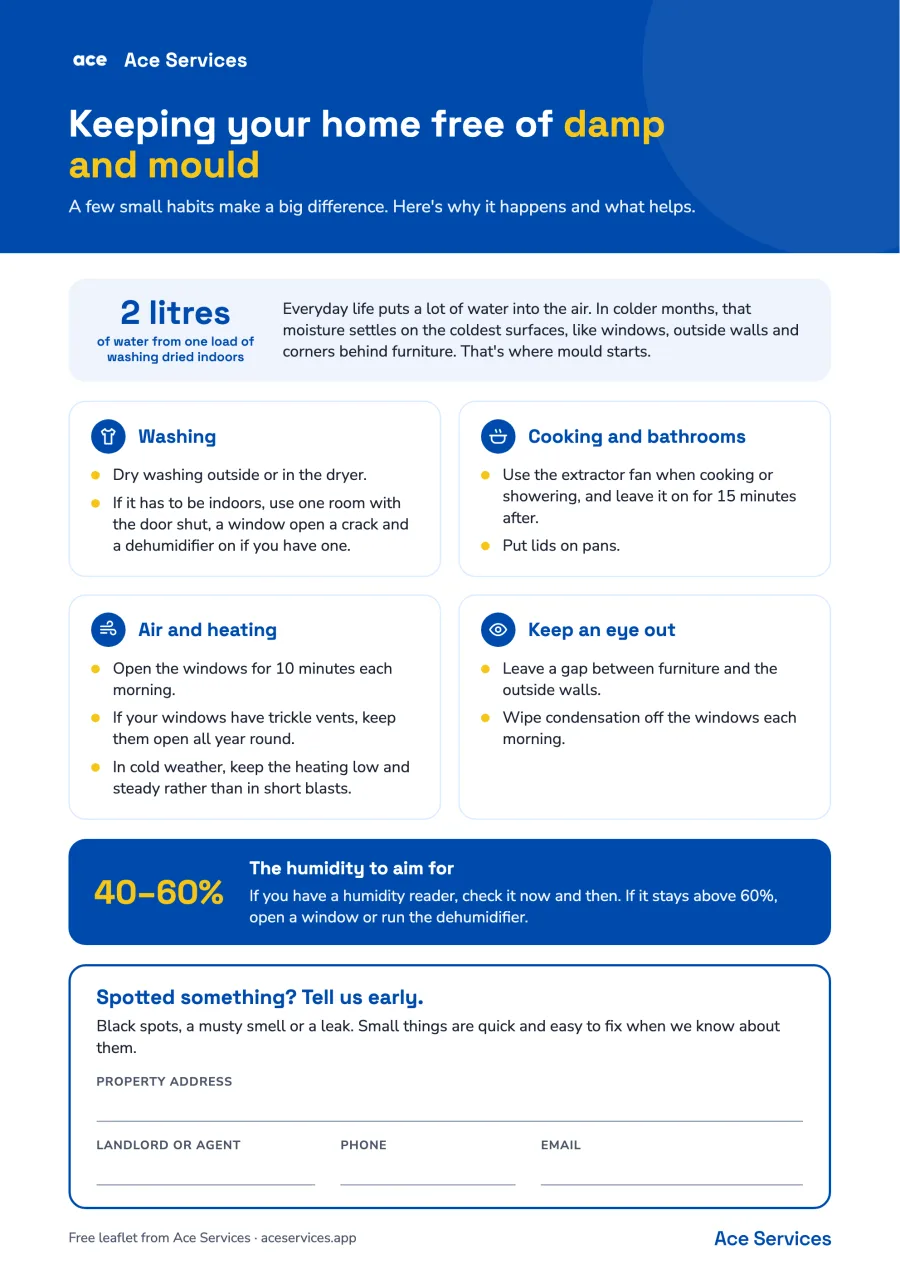
It opens with the reason, because tenants follow advice they understand: one load of washing dried indoors puts around 2 litres of water into the air, and in colder months it settles on the coldest surfaces, which is where mould starts. Then the habits that help:
- Washing: dry it outside or in the dryer, and if it has to be indoors, in one room with the door shut, a window open a crack and a dehumidifier on.
- Cooking and bathrooms: the extractor fan on, and left on for 15 minutes after. Lids on pans.
- Air and heating: windows open for 10 minutes each morning, trickle vents open all year, and heating low and steady rather than in short blasts.
- Keep an eye out: a gap between furniture and outside walls, and condensation wiped off the windows each morning.
- Humidity: aim for 40 to 60%, and open a window or run the dehumidifier when it stays above that.
The bottom of the page asks the tenant to report black spots, a musty smell or a leak early, with space for you to write in the property address, your name, phone number and email. Tips that need equipment are worded so the leaflet suits any home.
What a leaflet on its own does not cover
Government guidance on damp and mould, published in 2023, tells landlords not to put damp and mould down to tenants' lifestyle. The council can act under the Housing Health and Safety Rating System, and a leaflet is not a defence if the home makes condensation hard to avoid. Four things make more difference:
- Give tenants an easy alternative to the airer. A dehumidifier with a laundry setting costs a fraction of a tumble dryer to run, and tenants often use one when they will not pay to run a dryer.
- Rule out the building first. Leaking gutters or pipes, blocked air bricks, and soil or paving piled above the damp course. In older homes with solid walls, cement render or modern paint over lime can trap moisture too.
- Make ventilation automatic. Humidity-controlled extractor fans switch on by themselves, so they work when tenants forget. Where condensation keeps coming back, a positive input ventilation unit, in the loft or on a wall in a flat, is a common fix.
- Keep a record. What you provided, when you checked, and when each problem was reported and fixed. That record is what matters if it is ever questioned, and it will matter more when Awaab's Law is extended to private rentals, which has no date yet.
Common questions
Is there a free damp and mould leaflet landlords can give tenants?
Yes. Ace Services has a free one-page damp and mould leaflet for tenants, as a printable PDF with no sign-up. It explains why condensation forms and covers drying washing, extractor fans, airing rooms, heating and the 40 to 60% humidity to aim for, with space at the bottom for the property address and the landlord's contact details.
Who is responsible for damp and mould in a rented home?
It depends on the cause, and the landlord has to find out which. Damp from a leak, a structural defect, rising damp, or a home that cannot be heated or ventilated properly is the landlord's to fix under Section 11 of the Landlord and Tenant Act 1985 and the Housing Health and Safety Rating System, and a home with serious mould can be unfit for human habitation. Condensation from day-to-day living is the tenant's to manage, but only if the home gives them a fair chance to.
Can a landlord blame damp and mould on a tenant drying washing indoors?
Not on its own. Government guidance on damp and mould published in 2023 tells landlords not to put damp and mould down to tenants' lifestyle, and to look for the underlying cause instead. A landlord can still ask tenants to dry washing outside or in a dryer, but should also make sure the home has working extraction, ventilation and heating, and an easier option such as a dehumidifier.
What humidity should a home be kept at to prevent mould?
Between 40% and 60% relative humidity. Mould grows readily when the air stays above about 70% for long periods, and condensation forms on cold windows and outside walls well before that. A cheap humidity reader tells a tenant when to open a window or run a dehumidifier.
What should a landlord do when a tenant reports mould?
Look at it promptly, find the cause and fix that, not only the mould. Check for leaks, blocked gutters, blocked air bricks, soil or paving above the damp course, and extractor fans that do not work, then treat the mould and redecorate. Keep a dated record of when it was reported and what was done. On Ace Services, a tenant can report it through the property's link with photos, and that record is kept for you.